Duck Calling Tips & Tactics From Three-Time World Champion John Stephens
Author
SITKA Editorial Team
Category
Tips & Tactics
Read time
6 min
Last updated
May 7, 2026
Three-time duck calling champion John Stephens won't trust a call until he's recorded and played it back first.
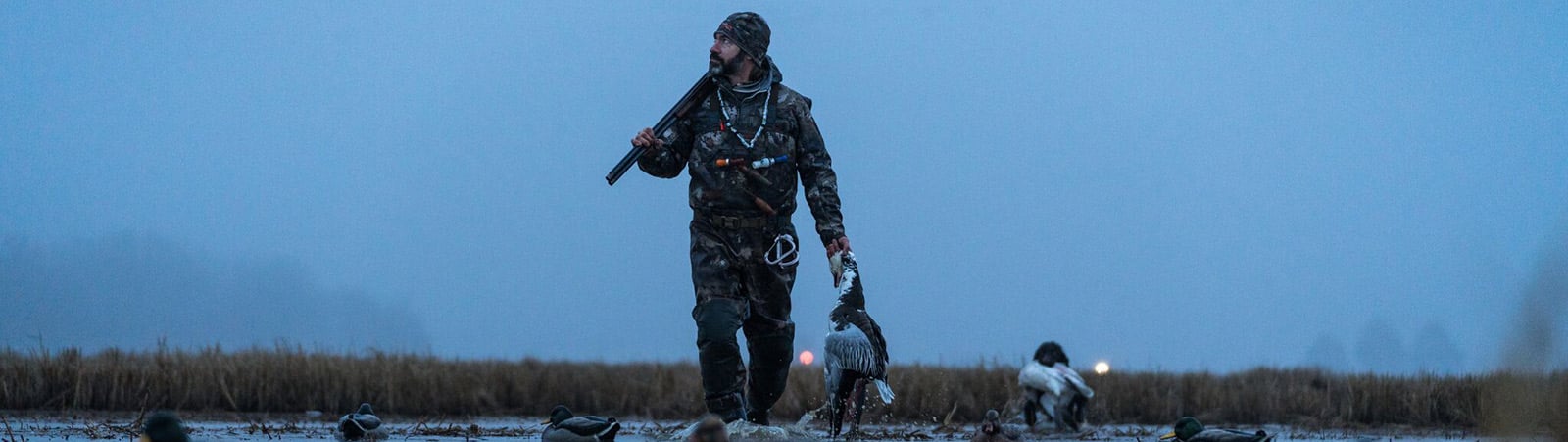
When it comes to duck calling, few people on the planet carry more authority than John Stephens - three-time world duck calling champion and owner of RNT Calls. At SITKA, our pursuit of the world's most technical hunting apparel means surrounding ourselves with the world's most skilled hunters. John is one of them.
Whether you're looking for beginner duck calling tips or you're a seasoned waterfowler trying to sharpen your skills, the tactics below represent a lifetime of obsessive refinement. These are the things John actually does - every duck hunt, every season.
Key duck calling tips at a glance:
Darkness deters - eliminate all light on the approach and setup
Rotate your spots relentlessly - more habitat, less pressure. Educated ducks don't respond to calling no matter how good you are
You can't improve what you can't hear - record your calling practice sessions and listen to them back
Soak your tone board before every hunt for a more natural, consistent sound
How Does a Duck Call Work?
Before diving into tips for better duck calling, it helps to understand the tool itself. A duck call works by forcing air across a reed - typically made from mylar or wood - which vibrates against a tone board to produce sound. The shape of the barrel and insert control the pitch and tone. How you control your air pressure, tongue position and hand position over the bell of the call determines whether you're making a convincing hen mallard or something that clears a hole in the sky.
Wooden duck calls, which John prefers, naturally produce warmer, more organic tones than acrylic or polycarbonate calls - closer to the real thing, especially in calm or cold conditions.

John Stephens, three-time world duck calling champion, blows into a wooden duck call
Don't Use Lights
I travel to the blind in absolute darkness - no light on the side-by-side to the boat launch, no light on the boat, and no lights during setup. Total blackness.
We know the birds are going to be there, and we don't want to give them any indication we will too. Most of our spots are large areas - like a 350-acre reservoir on our own property - where birds rest on open water overnight. We hunt the shallow buck brush as the sun comes up and ducks move in from open water and fields. Too much commotion, and you've burned the spot before shooting light. We hunt fields the same way. Will lights really turn ducks away? We believe so.
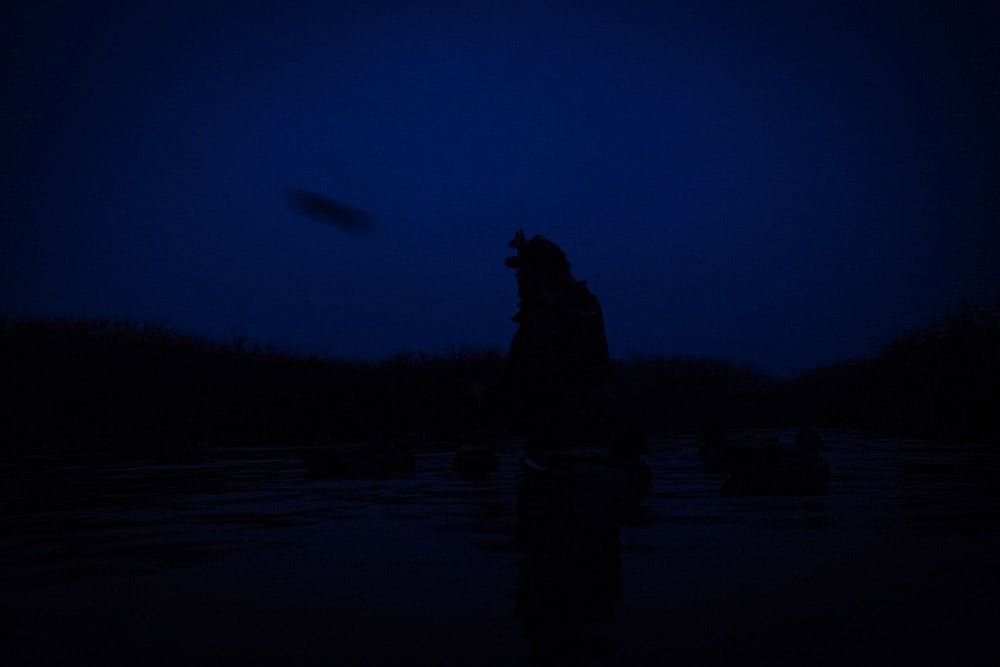
John Stephens hunts ducks in the dark
Have Rituals
I like to prepare for each hunt with the ritual of making each hunter a lrudimentary duck strap. Believe it or not, I am a traditionalist. I use twine because that’s what the old guides at the club used. They cut their string every morning for each hunter’s limit. They would say “if you don’t believe you are going to get ‘em this morning, then you probably won’t.”
It’s also important to know who has what birds on their limit, and what the count is. It’s so ritualistic for me that I have a custom made stinger-device that holds and measures each piece of twine.

A hunter holds a twine limits string for duck hunting
Don't Over Hunt Your Areas
I’m extremely sensitive about not putting pressure on your duck hunting and calling spots. We always say you don’t have to have a single “A” spot, but rather have multiple “B” spots and put parameters on them. We even have some areas where we hunt ducks early in the season then we flood others midseason and late season.
Our view is “more habitat = less pressure,” and it keeps your birds coming back.
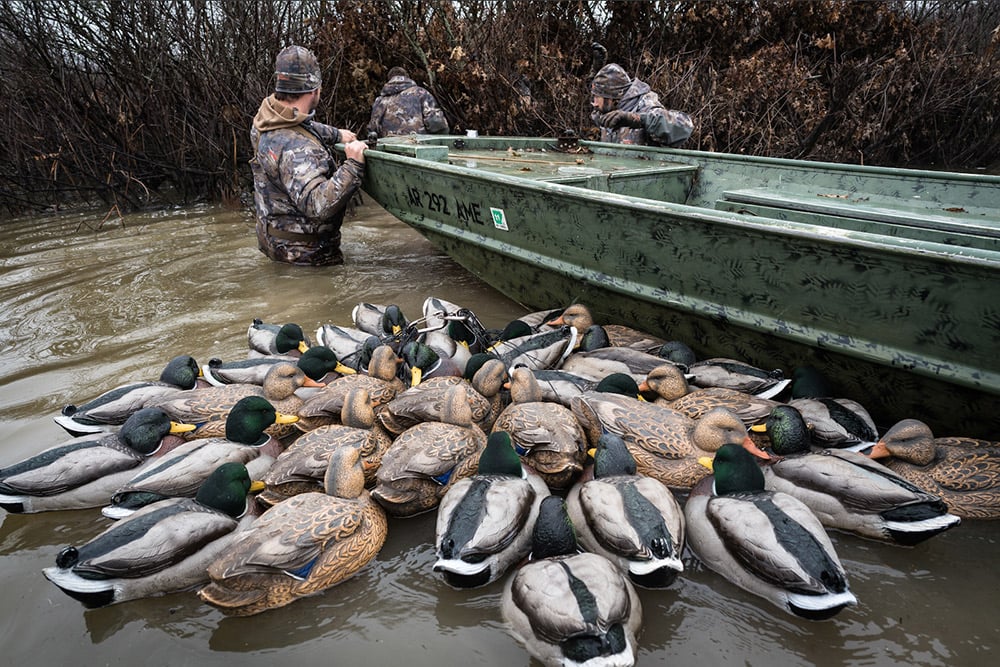
Camouflaged duck hunters stand in shallow water beside a green boat, arranging mallard decoys
Spending time in cold weather and cold waters? Know: What to wear duck hunting
Become Obsessed With the Sound of Your Calls
Here's one of the most important duck call tips I can give: you cannot improve what you cannot hear.
I'm fanatical about duck calls - how they work, how they're designed, their history as American folk art. I have a vintage collection of over 400 calls dating from the late 1800s through the 1960s, and I study them year-round. That obsession has made me a better caller, a better call maker and a better ambassador for waterfowling heritage.
I prefer wooden calls. Wood is natural, and to my ear it produces a more natural sound - one that's harder for pressured ducks to distinguish from the real thing.
My morning routine:
I remove my call stoppers and soak them in water for a few minutes to saturate the tone board. My thinking: if ducks are made of 70% water, the tools we use to replicate their voice should be too.
Then I record short video clips of each call I'm considering that morning and play them back. Calls sound different in different environments - cold air, timber, open marsh - and you're always behind the sound when you're blowing. The playback tells the truth. Whichever call sounds best on that recording goes on my lanyard. That's it.
Editorial by John Stephens, Expert Duck Caller
John Stephens is a Stuttgart, Arkansas–raised waterfowler, master call maker and three-time World Duck Calling Champion (1995, 1998, 2005). A lifelong student of the craft, he began competing as a youth and went on to lead Rich-N-Tone Calls, blending tradition, innovation and elite-level calling into both his hunting and design.
See more from John at:
@jstephenscalls (Instagram)
@J.StephensCalls (Facebook)
Articles with ducks.org
Final Thought
The best duck calling tips and tricks in the world won't replace time in the marsh - but they can dramatically shorten the learning curve. Study your calls. Manage your pressure. Move in darkness. And never stop listening.
John Stephens is the three-time world duck calling champion and owner of RNT Calls. SITKA works with the world's most skilled hunters to build apparel worthy of the pursuit.
You Might Also Like…
Article Contents

What do I need for duck hunting?
Making a duck call requires patience, knowledge, and special tools. This is a quick description. Begin by drilling a hole in the wood or acrylic barrel, then round the barrel on a lathe to the desired size. Next, install and pin the band before finishing the barrel on the lathe. Now it’s time to turn the insert tenon on the lathe. Make sure it fits snug, then drill the tone channel before tuning the toneboard.
How to tune a duck call?
Tuning a duck call doesn’t have to be complicated. For single-reed calls, remove the reed and adjust the Mylar reed. You can cut small slivers off it, but the more you trim, the higher the pitch of the call will become, so be conservative. A double-reed call is more challenging because it has more parts, and moving any of them changes the sound. Moving the wedge backward or forward is the simplest way to tune a double-reed call.
Who invented the duck call?
In 1863, it’s believed that Fed Allen created the first modern duck call with a barrel, stopper, and reed. Elam Fisher received the first patent for a duck call in 1870.
Where to get a duck call?
You can get a duck call at most sporting goods stores, online, at trade shows, and from other duck hunters.

Stay Connected
Join our community.
Get the latest gear innovations, SITKA films, expert insights, and more delivered to your inbox.
By providing your email and clicking "Sign Up", you agree to receive marketing emails from SITKA GEAR. You can unsubscribe at any time by clicking the link in any email. For more details, see our Privacy Notice and Terms & Conditions