Every deer hunter eventually learns the same hard truth: a few inches matter.
The difference between a clean pass-through and a long night tracking often comes down to shot angle, patience and knowing exactly where to aim before the moment shows up.
If you’re wondering where do you shoot a deer for the highest-percentage shot, it starts with understanding how a deer is built, how different shot angles change your aiming point - and when you should wait for a better opportunity.
The best hunters are disciplined enough to pass shots that don’t feel right.
Key takeaways:
The best place to shoot a deer is the heart/lung area just behind the front shoulder.
Broadside and quartering-away shots offer the highest percentage opportunities for both bow and rifle hunters.
Bowhunters should avoid heavy shoulder bone and focus on pass-through angles.
Rifle hunters can ethically take slightly steeper angles because of increased penetration.
Shot placement changes depending on deer angle, elevation and weapon choice.
Head shots and hard frontal shots carry a much smaller margin for error and are generally avoided by experienced hunters.


A female bow hunter dressed in camo aims from a treestand.
It’s so important to learn about animals’ anatomy that people spend much of their hunter education studying it. After all, the last thing we want is a wounded deer.

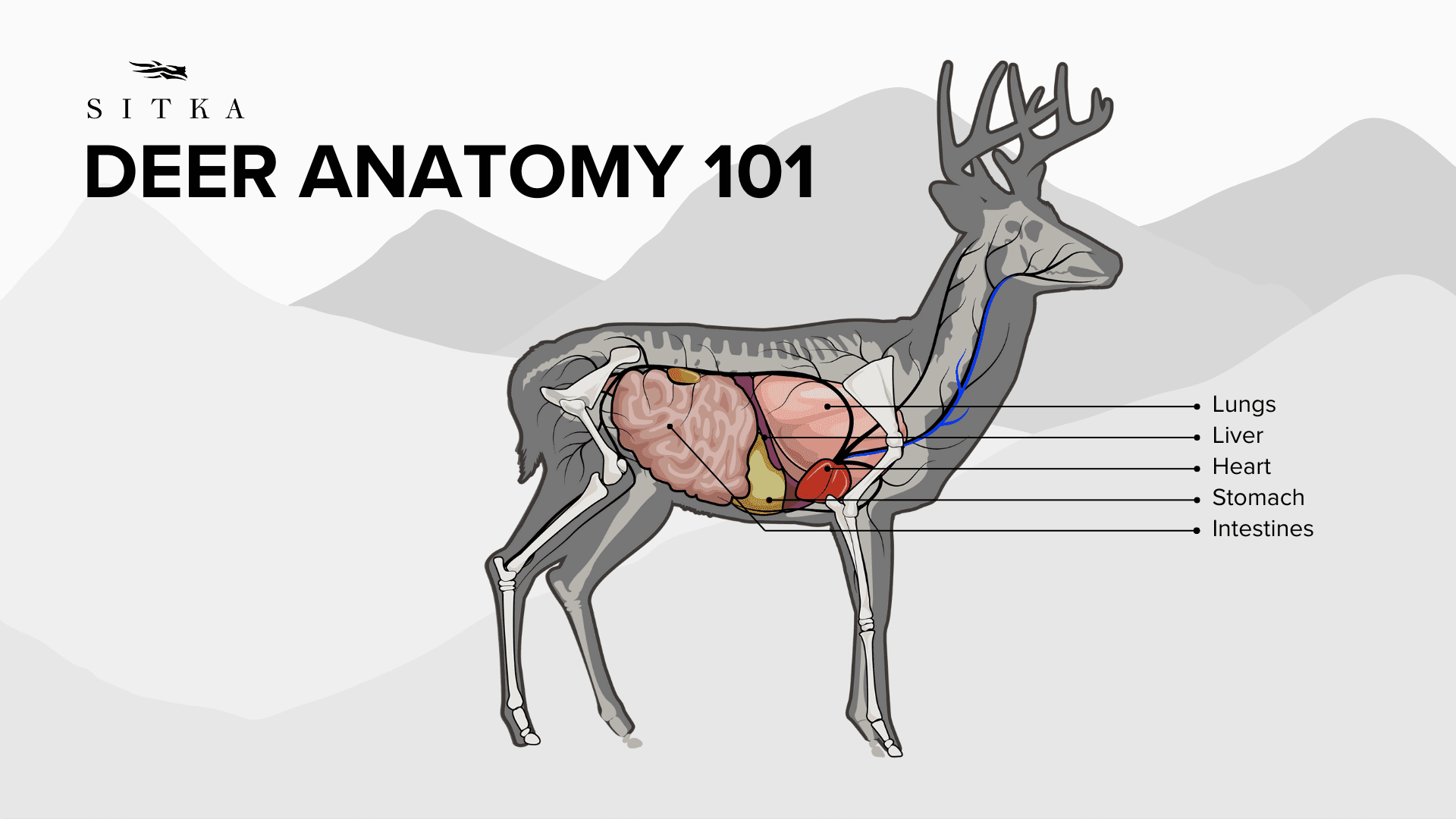
Deer Anatomy Diagram
Understanding Deer Anatomy
Before worrying about pins, crosshairs or broadheads, you need a clear picture of what’s actually inside a deer’s chest cavity.
Deer hunters should learn how to kill deer quickly and humanely. Hitting the vital organs is crucial for a quick harvest, and anyone serious about hunting deer must be serious about getting this right.
Vital Organs For Ethical Shots
For both bow and rifle hunters, the heart and lungs are the primary target.. Of course, other organs are vital for survival, including the liver, intestines and more. That said, these are not ethical shot placements, and it can take hours or even days before death. Because of this, most experienced hunters aim for the ‘boiler room’ - the heart/lung area tucked directly behind the front shoulder. It’s the largest vital zone on a deer and offers the best margin for error under real hunting conditions.
The ‘Boiler Room’ Explained
The area covering the top of the heart and the lungs is referred to as the boiler room. This area delivers a quick, clean, ethical kill. A well-placed bullet or broadhead that strikes this region is generally lethal within seconds.
Calm deer are easier to read and shoot, which is one reason many hunters pay close attention to camouflage while hunting deer.

A man wearing full camo aims his bow in the field.
Shots Most Deer Hunters Avoid
Every hunter eventually faces moments where the shot could happen - but probably shouldn’t. Experienced deer hunters learn to recognize low-percentage opportunities before adrenaline takes over.
Certain shot placements are simply not ethical and shouldn’t be taken, whether aiming with a bow or riffle. Head shots, for example, or arteries, liver, paunch, intestines - any vitals that will take a while to bleed out and kill the deer. Bowhunters should also never take neck shots, among others.
Why don't you shoot deer in the head? New hunters sometimes assume the head is the quickest kill shot, but most experienced deer hunters avoid it entirely.
A deer’s head is constantly moving, and the actual vital target is much smaller than people realize. Even slight movement at the shot can result in a wounded jaw, nose or facial injury instead of a clean kill.
The heart/lung area offers a much larger target and a far better margin for error.
While certain unethical shot placements should never be purposely taken, accidents do happen. Eventually, if a hunter hunts long enough, they’ll make a poor shot, even under the best circumstances and intentions.
When this occurs, give deer ample time to expire before blood trailing. Or, if possible, follow up immediately with a second shot.
Sometimes, regulations permitting, it might require a deer tracking dog. Other times, it might require several people grid-searching an area. Regardless, do everything in your power to recover wounded game.
Where To Shoot A Deer From Different Angles
As taught in hunter ed, a broadside deer is still the highest-percentage shot in hunting.. Of course, hunters aren’t always presented with the perfect shot opportunity, but that doesn’t mean others aren’t ideal or ethical. eer provide many viable shot angles. A hunter wants to strike the heart and/or both lungs (i.e.: a double-lung hit) for the fastest succumbing to the shot. That can be achieved through several shot types.
Broadside Shots
A broadside shot is the ideal. The best aiming point for a deer standing broadside, is right behind the crease of the front leg. That said, bowhunters and rifle hunters often use slightly different aiming points. Weapon type influences the process. Heed the following tips for archery and gun hunters.
Bowhunters should pick a spot tight behind the front shoulder and focus on driving the arrow through both lungs. With a deer’s legs perpendicular to the ground, imagine a line running up the back of the front leg. Aim along that line approximately a quarter to a third up the animal’s torso. This will cause the arrow to strike the heart and lung region of the deer.
Firearm hunters can use the same aiming point. That’s perfectly acceptable. However, some gun hunters choose to aim slightly more forward, and slightly higher, targeting the deer’s heart and lung region. Sometimes, this can produce more ‘shock’ effect, and might cause the deer to travel a shorter distance, or even drop in its tracks.

A hunter in an orange cap aims carefully, shooting for an ethical harvest.
Quartering Away Shots
If you could hand-pick a shot angle as a bowhunter, it would probably be quartering away.
A slight quartering-away deer opens the rib cage and gives your arrow a clean path forward through both lungs without forcing it through heavy shoulder bone. It’s one of the highest-percentage shots in deer hunting because the vitals stay exposed while the near-side leg moves out of the way.
For bowhunters wondering where to shoot a deer with an arrow, focus on the exit point - not just the entry. Pick a spot behind the shoulder that allows the arrow to travel diagonally through the chest cavity and exit near the opposite-side front leg.
Rifle hunters can take advantage of this angle too, especially at moderate distances where penetration and expansion remain reliable.
The key is not getting too far back. As the angle steepens, the margin for error gets smaller and the risk of liver or gut hits increases quickly.
Quartering-To Shots
Quartering-to shots are far less forgiving, especially with archery equipment.
When a deer angles toward you, the near-side shoulder begins covering the vitals and reduces the path an arrow or bullet can take through the chest cavity. For bowhunters, that heavy shoulder bone can stop penetration before the arrow ever reaches both lungs.
Most experienced hunters wait for a deer to turn broadside or quarter away rather than forcing this shot.
Rifle hunters have a little more flexibility because modern hunting bullets penetrate deeper, but the target window is still smaller than many hunters realize. Even slight movement at the shot can shift impact into shoulder meat instead of the heart/lung area.
If you’re unsure whether the vitals are fully exposed, it’s usually best to stay patient and let the deer take another step.

A successful deer recovery after a well-placed shot.
Frontal Shots
Frontal shots are controversial for a reason.
While some rifle setups can penetrate deeply enough for a lethal frontal shot at close range, the target window is small and angles change fast if the deer moves.
Most hunters wait for the deer to turn broadside or quarter away instead.
Elevated Shots
Treestand shots change the entry and exit path more than most new bowhunters realize.. In fact, shot placement and aiming points change when hunting from any elevated positions, including from higher terrain.
When a deer is on the same plane as the hunter, a change in up-and-down aiming point is not necessary. But when higher or lower than the deer, it’s crucial to adjust the aiming point.
The most common scenario involves the hunter being higher than the deer. When this occurs, hunters should aim slightly higher. This ensures a double-lung hit, rather than the single-lung result. Aiming too low risks striking only the near-side lung.
If the deer is at a higher position, move the aiming point slightly lower to get the desired shot placement. Aiming too high can also result in striking only the near side lung.
Staying comfortable and still during long sits matters - especially once temperatures drop deep into the rut. Here’s what to wear deer hunting.
Special Considerations
Certain situations call for special considerations. Read more about understanding shot angles and the challenge of moving targets.
Understanding Shot Angles
Different angles affect the path of a bullet or arrow through a deer's body. A good practice is to visualize the shot.
Consider other deer around the target animal. Is there a deer in front of it? Is there a deer behind it? If so, and another deer is in the arrow or bullet’s line of travel (before or after striking the target), don’t shoot. Also consider what else is behind your target. There could be campsites, hikers, houses or unknown territory behind your target.
The Challenge Of Moving Targets
It’s a hard ask shooting at moving deer. But certain strategies can increase your odds of success.
Bowhunters should never take a shot at a moving deer. Hunters should wait for the deer to stop walking before taking a shot. Even for the best archers, arrow speeds are not high enough for accuracy on a moving target.
Rifle hunters on the other hand have more flexibility on slow-moving deer, because bullets cover distance so quickly. But that doesn’t mean every moving shot is smart.
Whenever possible, wait for the deer to pause naturally before shooting. Of course, the distance to target, target rate of speed, wind speed and more, also impacts how much the shooter should hold and should be brought into the equation.
Broadheads, Bullets & Practice
Equipment also plays a role in how and where you shoot deer. The speed of your projectile (measured in feet per second), makes shots easier or more difficult. Of course, hunters must practice to learn how much they should alter their hold (aiming point) under different circumstances.
Choosing The Right Gear
Begin by selecting the best gear for the job. Find a bow or rifle that best fits you. You must feel comfortable with the weapon to be effective with it.
The Importance Of Practice
Even perfect shot placement can fall apart with lack of practice. Regular practice builds shooting accuracy. Practicing both typical and difficult hunting scenarios elevates personal skill level.
Bowhunters should choose broadheads for deer that fly accurately from their setup and provide dependable penetration through ribs and lung tissue. Rifle hunters should spend time practicing from realistic field positions.
Spend ample time (weekly) honing the craft. It’s important to know the distance you’re confidently accurate with and don’t be tempted to take shots over that distance. Have a distance in mind before going out and stick with it, rather than trying to decide whether or not to take a shot during a heated moment in the field.
SITKA Gear's Commitment to Ethical Hunting
Good deer shot placement starts long before the season opener.
It comes from studying anatomy, practicing from realistic positions, learning when to wait and understanding how angles change the path of an arrow or bullet through the chest cavity.
The goal is always the same: a quick recovery and the kind of shot you’d be proud to make again. SITKA Gear's deer hunting apparel is crafted to help you achieve accurate and ethical shots. Only with quality hunting clothing that keeps youdry can you remain comfortable, relaxed and ready to make a good shot. Secondly, quiet clothing helps hunters move, draw their bow or shoulder their gun, without alerting deer. A calm, relaxed deer is an easier target than an alert one.
Joe Fields
Joe Fields represents the mindset behind the SITKA community — disciplined, prepared, and shaped by time spent in wild places.